AI System
AI Production System
The “engine room” behind Elenavision
What becomes visible on social media is only the final layer.
Behind Elenavision there is no single AI model, nor a simple process based on the principle:
Enter prompt. Generate image. Post.
Underneath the characters is a production system made up of specialised AI roles, generative image and video systems, language, data, automation and human decision-making.
We call this technical and organisational “engine room” the AI Production System of Elenavision.
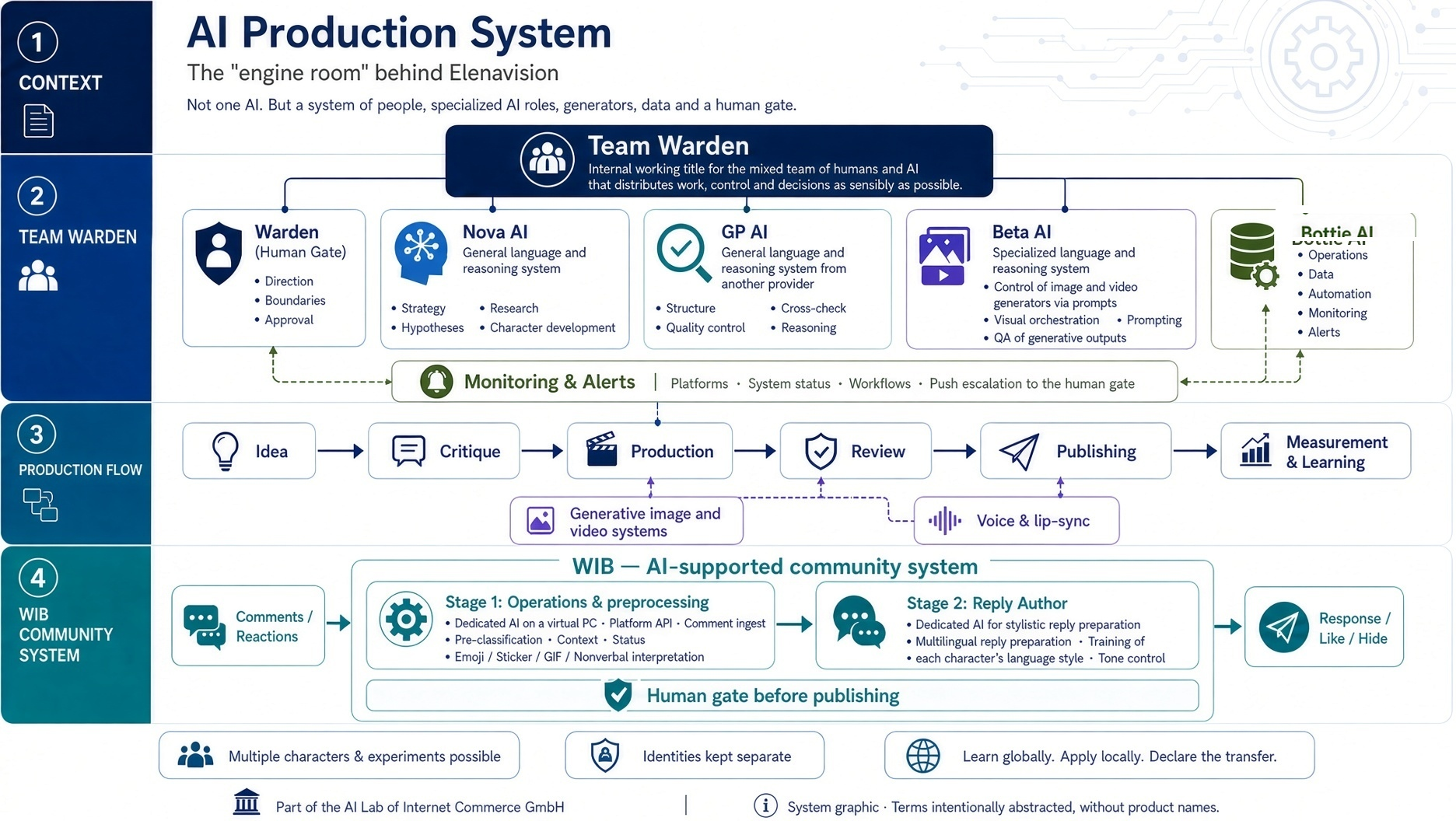
Not one AI. A system.
Different tasks require different strengths.
One system may be excellent at research but unable to produce a stable visual identity.
Another may generate strong images but be unable to reliably assess either the strategic meaning of a result or the long-term development of a character.
Other systems are particularly strong in language, analysis, data processing or recurring technical workflows.
That is why Elenavision does not try to do everything with a single AI.
Tasks are broken down and handled where the relevant strength lies.
These include, among other things:
- strategy and research
- character development
- language and editorial work
- visual conception
- image and video production
- Voice & Lip-Sync
- technical orchestration
- data and measurement
- community management
- quality control
- human selection and final decision-making
The interesting part often does not lie in a single system.
It lies between the systems.
Team Warden
Team Warden is our internal working name for the mixed team of humans and specialised AI systems behind Elenavision.
The name refers neither to a product nor to a company.
It emerged during the ongoing work as individual tools increasingly developed into a fixed division of labour.
The goal is not to hand as much work as possible over to AI.
Nor is it to keep as many decisions as possible with humans.
The task is rather to divide work, control and responsibility so that humans and AI systems are each used where their strengths lie — and save each other as much unnecessary work as possible.
AI can research quickly, develop variants, produce, compare, measure and take over recurring processes.
Humans remain particularly important for direction, taste, context, ethical boundaries and decisions where responsibility should not be delegated to a system.
Internally, we summarise the idea like this:
Team Warden is not the sum of the team, but the multiplication of its strengths.
Warden — Human Gate
The Warden refers to the human decision-making and control function within the system.
This is where direction and boundaries are set, characters and content are assessed, and publications receive final approval.
AI systems may make proposals, disagree, develop alternatives and prepare decisions.
Final responsibility remains human.
Production and thinking can be distributed. Responsibility cannot.
Nova AI — universal language and reasoning system
Nova AI works primarily on strategy, research, hypotheses and character development.
This includes counterpositions, positioning, behaviour, the long-term development of a character and the question of which experiments make sense in the first place.
With Nora, Nova AI was already much more deeply involved in the original character conception than it had been with Elena.
For the first time, this meant that not only the production of a character was AI-supported, but also a substantial part of the character’s conception.
GP AI — universal language and reasoning system from another provider
GP AI takes on a partially overlapping but deliberately independent role.
This includes language, structure, critical integration, quality control and the examination of hypotheses and conclusions.
The fact that Nova AI and GP AI are based on systems from different providers is deliberate.
Assumptions can be cross-checked from different model perspectives instead of remaining inside a single AI logic.
One important task is to distinguish between observation, hypothesis and supposed certainty.
Not every plausible explanation is already a fact.
Beta AI — visual orchestration and quality control
Beta AI is not itself the actual image or video generator.
It is a specialised language and reasoning system that controls different image and video generators through prompts.
Elenavision therefore generally does not prompt these generators directly.
Between idea and generator sits an additional AI layer:
Understand task → develop visual prompt → control generator → inspect result → correct if necessary and generate again
Beta AI therefore also takes over part of the visual quality control.
Among other things, it checks whether identity, composition, spatial logic and the intended visual message actually work in the generated output.
A technically generated image is therefore not yet an approved image.
Beta AI is less a generator than an AI for controlling and supervising other generative AI systems.
Bottie AI — operations, data and infrastructure
Bottie AI handles the operational part of the system.
This is where interfaces, data, automation, status, measurement and recurring technical processes come together.
While other roles develop ideas, characters or content, Bottie AI keeps ongoing operations observable and structured.
These include, among other things:
- platform interfaces
- data ingest
- storage and status management
- automation
- Monitoring
- metrics
- technical preparation of community actions
Its job is not to replace taste.
Its job is to require as little taste as possible.
WIB — AI-supported community system
As the audience grows, a new difficulty emerges:
A synthetic character must not only look consistent.
She must also respond consistently.
That led to WIB, our two-stage AI-supported system for community management.
Comment / Emoji / GIF
AI Preprocessing
Reply Author
Human Gate
Response
WIB — Stage 1: Operations and preprocessing
A first AI runs in a dedicated virtual working environment and communicates with the social-media accounts through the platform interfaces.
Among other things, it handles:
- ingest of new comments and interactions
- technical assignment to posts and platforms
- preliminary classification
- detection of simple reaction cases
- status management
- preparation for moderation and Human Gate
The system does not process text alone.
Nonverbal communication is also part of the input:
- Emojis
- Sticker
- GIFs
- reaction images
- other visual attachments
The system tries to recognise their communicative meaning in the respective context and classify them accordingly.
A heart sticker and an insulting image stamp may both initially appear technically as nothing more than an attachment.
Communicatively, they mean something completely different.
WIB — Stufe 2: Reply Author
When an individual reply actually makes sense, a second specialised AI takes over.
This AI is trained specifically on the respective character’s voice.
For Nora, for example, that means:
snippy, charming, confident — but not sexually flirty.
The reply AI is not meant to simply generate grammatically appropriate sentences.
It is meant to keep the respective character style:
- consistent across different situations,
- usable across multiple languages,
- sensitive to humour and cultural context,
- adapted in tone and intensity to the respective comment,
- and able to learn from approved and rejected replies.
A comment in another language should therefore not simply be translated and answered generically.
The reply should sound like the respective character in that language too.
Community remains Human-gated as well
Both WIB stages may analyse, classify and prepare suggestions.
Individual community actions are still published only after human approval.
WIB therefore tests another question:
Can a synthetic character develop not only a stable visual identity, but also a recognisable, multilingual social identity over time — including nonverbal communication?
How the work is done
The AI Production System does not follow a rigid assembly line.
Depending on the task, the process may look different.
At its core, however, the same loop repeats:
Idea → Critique → Production → Review → Publication → Measurement → Learning
An idea may come from a human or an AI.
Other roles may criticise or reject it.
Production may be distributed across several systems.
Before publication comes the Human Gate.
After that, it is no longer the team that decides, but reality:
Platforms distribute a piece of content — or they do not.
People react — or they do not.
Measurable results then flow back into the system.
No system is automatically right
AI systems can sound convincing and still be wrong.
Humans can too.
That is why Elenavision tries not to confuse hypotheses with results.
A strong post does not prove a universal formula.
A weak post does not automatically disprove a character.
And unusual growth may be the result of good decisions — or partly just luck.
Pixels and data beat theory.
If reality contradicts a previous assumption, the assumption is changed.
Not reality.
Learning without identity mush
Insights should be usable across experiments.
But not everything may be transferred.
A production method that works for Nora may also be useful for a later character.
A better workflow for image composition may help Elena.
Insights about platforms or community management may likewise be passed between experiments.
The characters themselves, however, remain separate.
Elena’s identity is not adapted to Nora.
Nora’s visual or linguistic traits are not automatically transferred to another character.
Our internal rule is:
Learn globally. Apply locally. Declare the transfer.
Methods may learn.
Identities have a firewall.
AI-led. Human-gated.
Elenavision does not try to simulate fully autonomous AI production.
Autonomy is not an end in itself.
If humans can decide a task better, faster or more responsibly, it stays with the human.
If AI can take over routine work, research, production or analysis more effectively, it is used there.
The goal is not a competition between human and machine.
The goal is the best possible division of labour.
AI-led where useful. Human-gated where it matters.
Museum of AI Operational Accidents
When artificial intelligence pursues the wrong thing with impressive consistency.
Part of the AI Lab
Elenavision is a concrete experimental setup within the AI Lab of Internet Commerce GmbH.
The AI Lab works more broadly on Visual AI, synthetic identities, image and video AI, language, voice, as well as local and cloud-based systems and the question of how robust workflows can be built from them.
Elenavision brings part of that work into real-world conditions:
real platforms, real distribution, real reactions — and results that are not predetermined.